infrastructure
NRW returns 500 tonnes of boulders to dredged Afon Wern in Cleddau catchment
Natural Resources Wales's Four Rivers for LIFE project has reinstated boulders along 650 metres of a Cleddau tributary, notched a redundant weir and reconnected the river to its floodplain in Pembrokeshire.
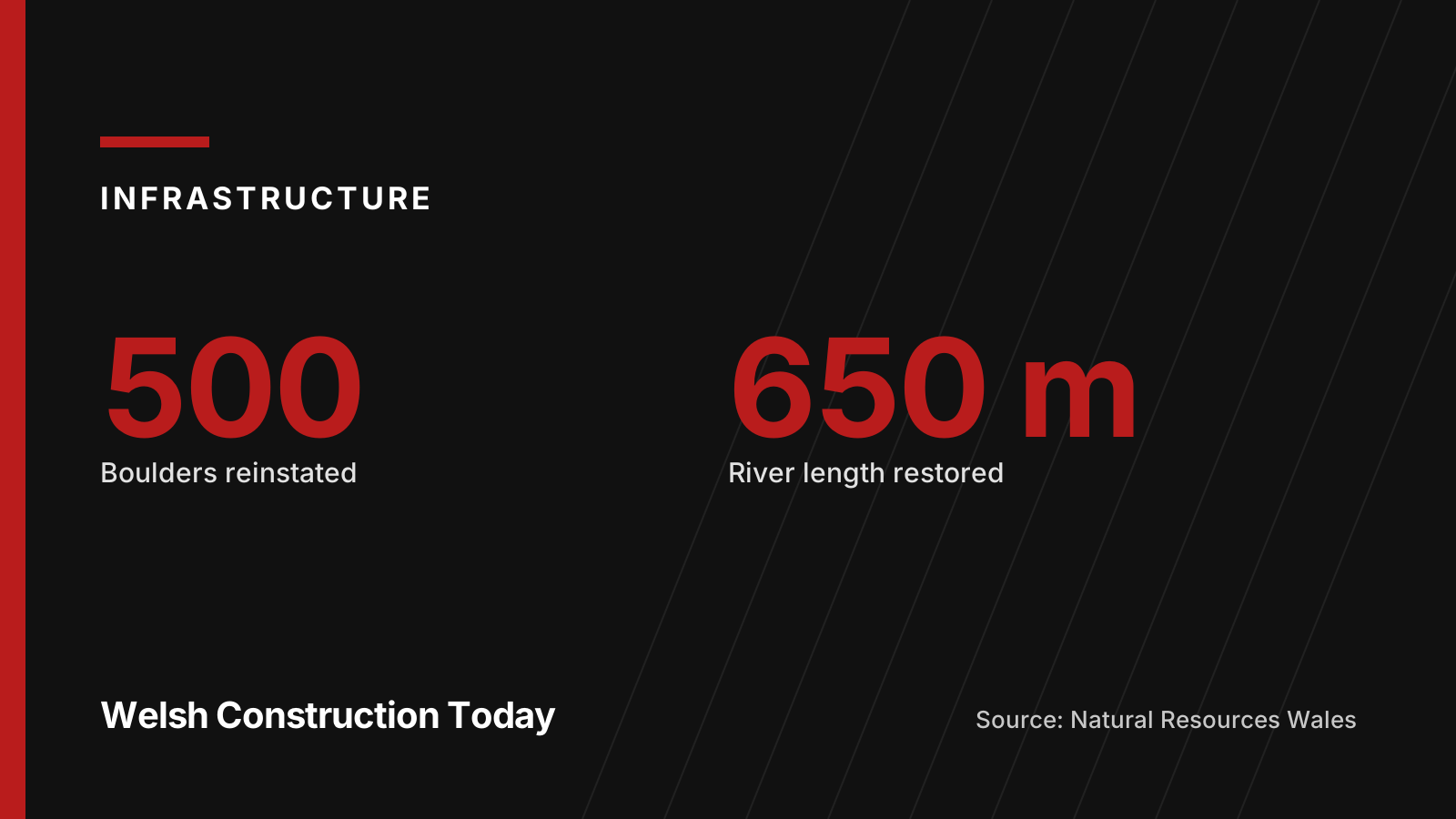
Natural Resources Wales (NRW) has put 500 tonnes of boulders back into a 650-metre stretch of the Afon Wern in Pembrokeshire, a tributary of the Cleddau River Special Area of Conservation (SAC), under its Four Rivers for LIFE project.
NRW said the stretch had been dredged in the past, and surveys by its staff confirmed this when the boulders removed from the channel were found lying along the riverbank. Contractors placed them back into the river over the summer. NRW's announcement, published on 9 November, names neither the contractor nor the cost of the scheme.
The boulders are intended to break up the flow and create a wider range of habitats for fish and invertebrates, NRW said, as well as holding back gravel needed for spawning.
Peter Jones from the Four Rivers for LIFE project said: "By working with natural processes, we are restoring ecosystem resilience of the Afon Wern and improving habitat quality for fish and other wildlife."
Floodplain and weir works
Alongside the boulder placement, a new channel was dug to let the river flow out during heavy rainfall and reconnect with its floodplain. Three drainage ditches in adjoining fields were blocked to hold water on the floodplain for longer, and shallow wetland ponds and scrapes were dug.
NRW said restoring natural flood dynamics at the top of the catchment would improve water retention, reduce flooding impacts further downstream and increase resilience to drought.
A notch was also cut into an obsolete concrete weir on the stretch. NRW said this immediately restored free fish passage and allowed gravel and boulders to move naturally again. Even very small weirs can block weaker-swimming species such as eel and lamprey and delay salmon and sea trout migrations, the agency said.
Jones said: "This restoration work will benefit numerous species including salmon, trout, bullhead, eel, lamprey and otter. We would like to thank local landowners and graziers for their support in delivering the scheme."
The wider programme
NRW has previously reported a boulder-reinstatement scheme on the Western Cleddau near Letterston, where it said the stones were believed to have been removed by dredging in the late 1960s.
Four Rivers for LIFE covers the Teifi, Cleddau, Tywi and Usk, all of which NRW says are in unfavourable condition because of multiple pressures. The project is led by NRW in partnership with the Brecon Beacons National Park Authority and others, and is funded by the EU LIFE Programme with support from Welsh Government.
According to NRW's project page, the programme aims to improve 776km of river in mid and south Wales, improve fish passage at 12 sites by tackling weirs and other in-river structures, re-meander and reconnect 5km of river to its floodplain, and restore 136 hectares of floodplain habitat. At launch in October 2022 NRW also set a target of reducing invasive non-native species along 180km of river.
NRW's own documents differ on the programme's length. The project page says the 776km will be improved over four years, while the October 2022 launch release said more than £9m would be spent over five years. The same release put the Welsh Government's contribution at more than £3.4m over four years.
In September 2025 NRW said the project had improved eight barriers to fish migration, with seven more to be addressed in 2025 and 2026. By the same date it had worked with farmers to install 25 miles (40km) of fencing and planted about 37,000 native trees.
The Welsh Government's written statement on its fourth river pollution summit, in March 2024, recorded an update from NRW on the project's work across the four SAC rivers.
On the record: Natural Resources Wales
Sources
- Natural Resources Wales (opens in a new tab) (accessed 2026-11-09)
- Natural Resources Wales (opens in a new tab) (accessed 2026-11-09)
- Natural Resources Wales (opens in a new tab) (accessed 2026-11-09)
- Natural Resources Wales (opens in a new tab) (accessed 2026-11-09)
- Natural Resources Wales (opens in a new tab) (accessed 2026-11-09)
- Welsh Government (opens in a new tab) (accessed 2026-11-09)
This story was researched from the primary sources above and checked against them before publication. Spotted an error? Tell us and we will correct it promptly.