policy
Welsh Government consents to three-month decision deadline for Transport and Works Act orders
Sian Gwenllian has agreed to UK regulations that set a statutory decision deadline, fold listed building and marine consents into TWA orders in Wales and take effect on 20 November 2026.

Promoters of rail, tram and harbour schemes in Wales will face a three-month statutory decision deadline on Transport and Works Act applications from 20 November 2026, after the Welsh Government consented to UK regulations rewriting the procedure.
Sian Gwenllian MS, Cabinet Minister for Local Government, Housing and Planning, told the Senedd on 3 November 2026 that she had agreed to the UK Secretary of State making the regulations for Wales. Under the 1999 Transfer of Functions Order, the UK Government can only make Transport and Works Act (TWA) rules applying to Wales with the agreement of the Welsh Ministers.
The 1992 Act is the consenting route for rail and tramway development, inland waterway schemes and harbour infrastructure. In Wales, TWA orders are decided by the Welsh Ministers, according to the Department for Transport's guide to the regime; in England the relevant Secretary of State decides.
Gwenllian said: "The amendments form part of the wider England and Wales legislative framework governing TWA orders and will improve the operation of the consenting regime in Wales."
What changes
The Welsh Government statement listed five changes. The first is a requirement for decisions on TWA applications to be issued within three months. The instrument on legislation.gov.uk, SI 2026/1143, sets this as three months from the later of receipt of the inspector's report or any further information requested after it. The amended inquiry rules also require the inquiry close date to be fixed no later than three months after it opens.
Second, listed building consent, and in Wales conservation area consent, will no longer need a separate application determined by the Welsh Ministers. Instead, the Welsh Ministers may direct that the consent is deemed granted when making a TWA order. Applicants must send a copy of the application to the local planning authority and reference it in the notice of application.
Third, marine licences under Part 4 of the Marine and Coastal Access Act 2009 will no longer require a separate application to Natural Resources Wales (NRW). The decision-maker may deem the licence granted through the TWA order, but applicants must consult NRW at pre-application stage and submit a draft marine licence with their application documents.
Fourth, shortened timescales will apply where an application is dealt with by written representations rather than a public inquiry. Fifth, where a TWA decision is successfully challenged in court, the Welsh Ministers will have to issue a Statement of Matters and give parties the chance to make written representations before re-determining the application.
Objection periods diverge
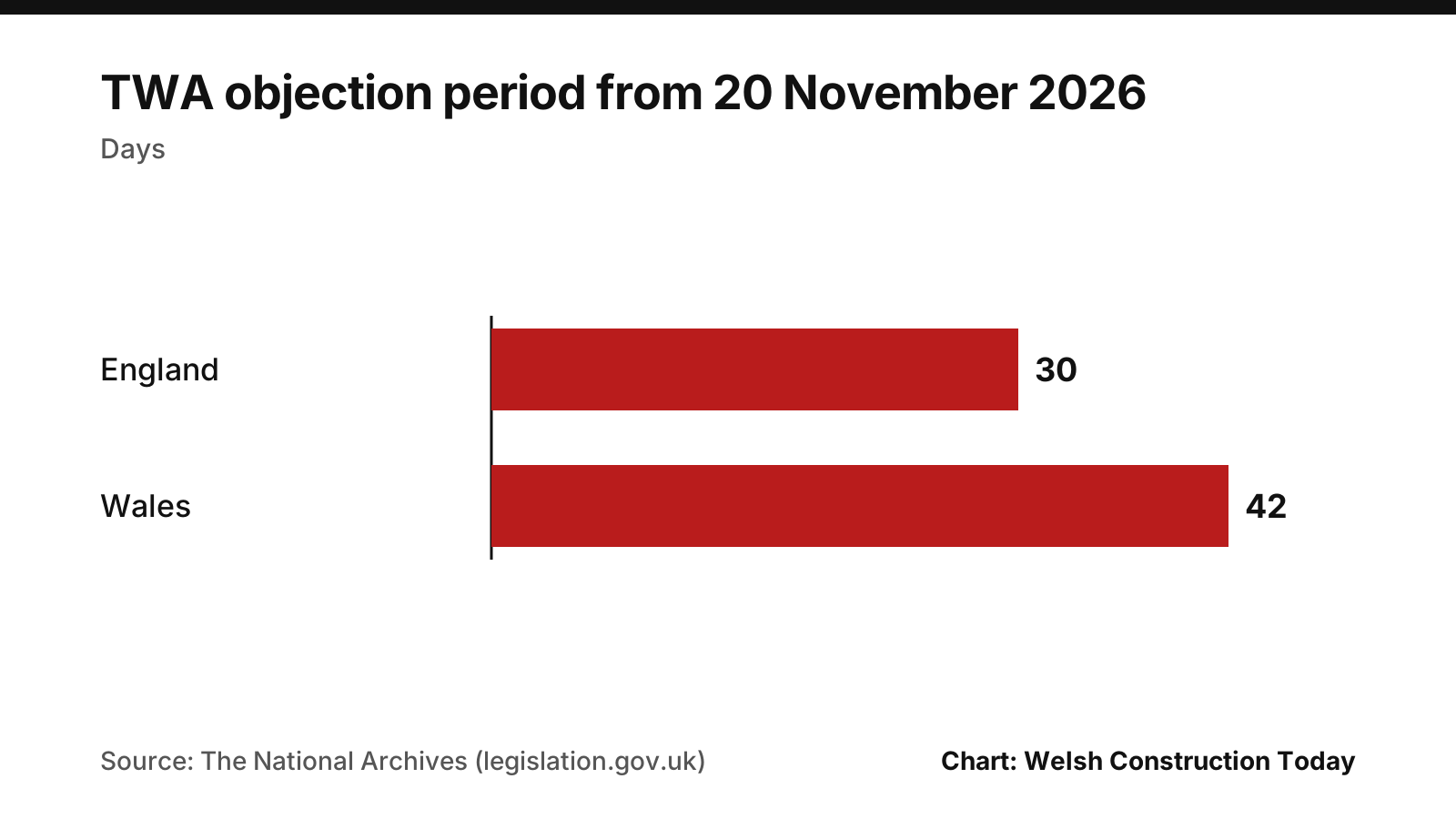
The made instrument cuts the objection period for TWA applications from 42 days to 30 days in England, while Wales keeps 42 days. The DfT guide records the same reduction in respect of England. The Welsh statement does not mention the objection period.
| Objection period from 20 November 2026 | Days |
|---|---|
| England | 30 |
| Wales | 42 |
Why Wales consented
The Welsh Government said Welsh Ministers cannot make equivalent provision on a Wales-only basis, so consenting to the UK regulations was the most effective way to achieve the policy objectives. Gwenllian said the decision was consistent with the Welsh Government's Principles on UK Legislation in Devolved Areas.
Those principles, set out by Julie James MS, Counsel General and Minister for Delivery, on 13 December 2024, start from the position that primary legislation in devolved areas should be enacted by the Senedd and secondary legislation made by the Welsh Ministers where they have executive competence. They also recognise circumstances where UK legislation may cover Wales with the consent of the Welsh Ministers in the case of subordinate legislation.
Gwenllian said: "I consider the amendments proposed benefit the TWA consenting system and align to our Programme for Government. The Regulations do not impact on the legislative competence of the Senedd".
The deemed listed building consent power rests on section 43 of the Planning and Infrastructure Act 2025, which inserts a new section 17A into the TWA allowing the Welsh Ministers to direct that consent is deemed granted. The legislation.gov.uk page for section 43 notes the section was not in force at Royal Assent and depends on commencement under section 118.
Timetable
The Welsh statement refers to the "proposed" regulations by their title without "(Amendment)"; legislation.gov.uk shows the instrument as the Transport and Works (Applications, Objections, Listed Buildings, Inquiries and Decisions Procedure) (England and Wales) (Amendment) Regulations 2026. It was made on 27 October 2026 and laid before the UK Parliament on 30 October 2026 under the negative procedure.
The regulations amend the Transport and Works (Inquiries Procedure) Rules 2004, the Transport and Works (Applications and Objections Procedure) (England and Wales) Rules 2006 and the 1992 listed buildings and conservation areas procedure regulations. A TWA order does not in itself grant planning permission, the DfT guide says.
The regulations come into force on 20 November 2026 and apply in full to relevant applications made on or after that date.
On the record: Department for Transport, Natural Resources Wales
Sources
- Welsh Government (opens in a new tab) (accessed 2026-11-03)
- Welsh Government (opens in a new tab) (accessed 2026-11-03)
- The National Archives (legislation.gov.uk) (opens in a new tab) (accessed 2026-11-03)
- Department for Transport (GOV.UK) (opens in a new tab) (accessed 2026-11-03)
- The National Archives (legislation.gov.uk) (opens in a new tab) (accessed 2026-11-03)
- Welsh Government (opens in a new tab) (accessed 2026-11-03)
This story was researched from the primary sources above and checked against them before publication. Spotted an error? Tell us and we will correct it promptly.