policy
NICW narrows remit to data centres and AI compute under new chair Jenifer Baxter
The National Infrastructure Commission for Wales will spend the next 15 months on AI infrastructure alone, mapping proposed sites with Arcadis and advising ministers on planning options in January.

The National Infrastructure Commission for Wales (NICW) has narrowed its remit to a single sector, AI infrastructure, data centres and compute, for the next 15 months under its new Chair, Dr Jenifer Baxter.
In a post published on 9 November, Baxter said the commission would keep its core values "but with a smaller Commission and a sharper focus". The remit was co-designed with the Welsh Government, NICW said, while the body keeps its position as an independent adviser.
The change marks a break from the previous four years under Dr David Clubb, when NICW's remit was to consider infrastructure needs from five to 80 years ahead.
Baxter, Chair of the National Infrastructure Commission for Wales, said: "Data centres are infrastructure for decades, not years. The decisions we take now will shape our energy system, our water resources and our landscapes long after today's technology has moved on."
The scale of proposals
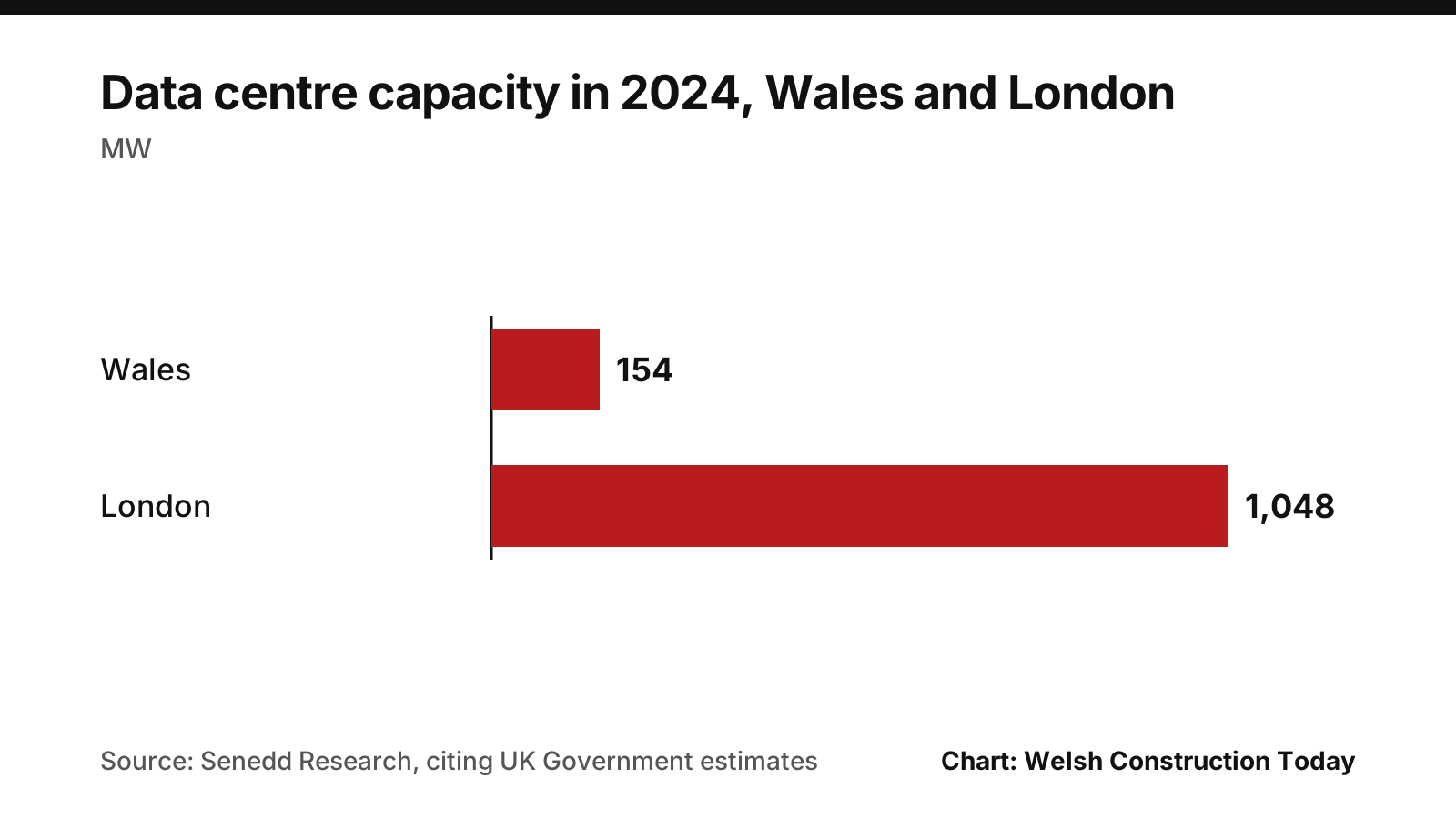
NICW said Wales had about 154MW of data centre capacity in 2024 and that roughly 1.45GW more is now proposed across sites in Cardiff, Newport, Bridgend, Anglesey and near Caernarfon.
Senedd Research, citing UK Government estimates, put the 2024 position in context against London.
| Location | Data centre capacity 2024 (MW) |
|---|---|
| Wales | 154 |
| London | 1,048 |
Two UK AI Growth Zones are being developed in Wales. The UK Government said the South Wales zone comprises several sites along the M4 corridor from Newport to Bridgend, with the potential to harness more than 1GW by the early 2030s. The North Wales zone has bases at Prosperity Parc on Anglesey and at Trawsfynydd in Gwynedd, and the UK Government said it would bring a total of 3,450 jobs.
Baxter said the growth zones could bring investment, skilled jobs and supply chain opportunities. "But so many proposals also raise real questions about electricity, water, land and noise, and about what the communities hosting new data centres get in return," she said.
The work programme
NICW said it would help Welsh Government officials build a Welsh policy framework for data centres and AI compute, and would also publish its own advice to the Cabinet Minister so that its view stays independent.
Working with Arcadis, the commission will map data centre sites in Wales that are operating, consented and proposed. The evidence work will cover grid, water, fibre connectivity, land and environmental constraints, and what UK demand forecasts mean for Wales. Draft technical notes are due before Christmas, with final papers at the end of January.
A professional advisory group drawn from energy networks, water, planning, data centre engineering and digital infrastructure will review the evidence and test policy options in January.
Between late November and mid-December, Next Generation Engagement will hold conversations with communities near proposed and existing sites in North and South Wales. NICW and its communications partner Equinox will also hold roundtables with industry, utilities, regulators, local authorities and planners, and the commission will publish what it heard in January.
Background
The Welsh Government set out the arrangements behind the new remit in a written statement dated 30 September 2026, issued by Adam Price MS, Cabinet Minister for Enterprise, Connectivity and Energy. It confirmed Baxter, previously interim Chair, as Chair until December 2027 and extended the terms of commissioners Eurgain Powell, Helen Armstrong, Nick Tune and Aleena Khan to the same date.
The statement said the Welsh Government is working across departments on a strategic policy framework for data centres and AI compute infrastructure in Wales, with a separate statement to follow. It is also considering NICW's future role, functions and organisational form as part of work on the design of a new economic development agency.
NICW was established in 2018 to give independent advice, the Welsh Government said. Its published terms of reference describe it as a non-statutory advisory panel.
What happens next
In January NICW will advise the Cabinet Minister on the Welsh Government's policy options, including what good looks like, where development should and should not go, and which planning tools would help. NICW said more on its 2027 work would follow in the New Year.
On the record: Arcadis
Sources
- National Infrastructure Commission for Wales (opens in a new tab) (accessed 2026-11-09)
- Welsh Government (opens in a new tab) (accessed 2026-11-09)
- Welsh Government (opens in a new tab) (accessed 2026-11-09)
- Senedd Research (Welsh Parliament) (opens in a new tab) (accessed 2026-11-09)
- UK Government (GOV.UK) (opens in a new tab) (accessed 2026-11-09)
- UK Government (GOV.UK) (opens in a new tab) (accessed 2026-11-09)
This story was researched from the primary sources above and checked against them before publication. Spotted an error? Tell us and we will correct it promptly.