infrastructure
NRW completes 700m large wood restoration on Afon Dunant near Llandovery
Natural Resources Wales' Four Rivers for LIFE project has installed 19 large wood structures and two beaver-style dams on a Tywi tributary on the Welsh Government Woodland Estate in Carmarthenshire.
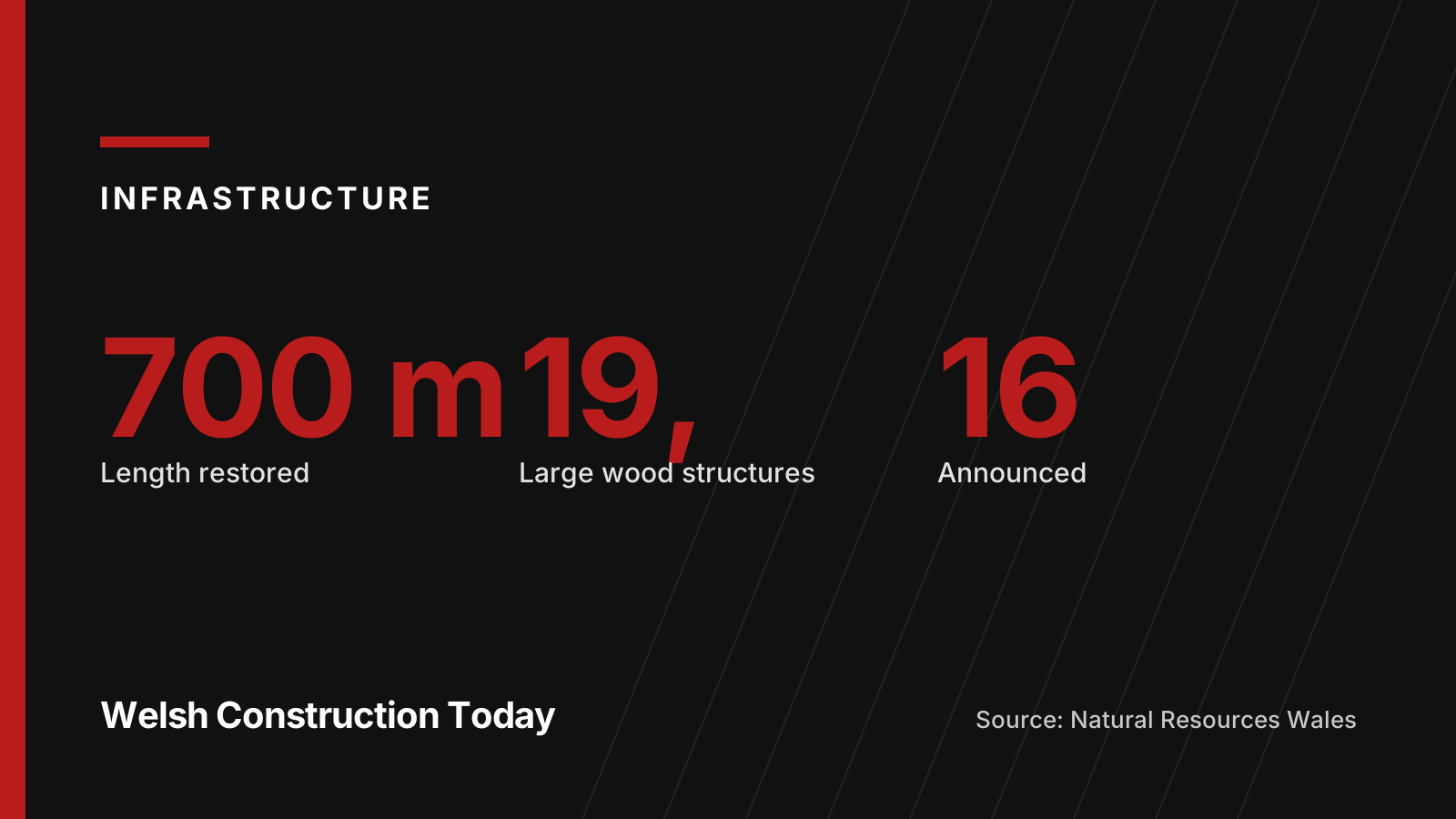
Natural Resources Wales (NRW) has completed a 700-metre river restoration on the Afon Dunant near Llandovery, installing 19 large wood structures and two beaver-style dams on a tributary of the River Tywi Special Area of Conservation.
The work, announced on 16 November 2026, was delivered over the summer by NRW's Four Rivers for LIFE project with contractors on part of the Welsh Government Woodland Estate. NRW did not name the contractors.
NRW said the scheme was designed to improve river habitat, restore ecosystem functioning and provide natural flood management benefits in the Carmarthenshire catchment.
Peter Jones from the Four Rivers for LIFE project said: "Trees were felled with root plates attached and keyed in against standing bankside trees to stop them from moving during flood conditions."
The works
The 19 wood structures were built to mimic trees falling into the channel during storms. NRW said large wood is lacking in Welsh rivers because of insufficient bankside woodland and historic and ongoing dredging.
Alongside the wood, the team dug two channels into the banks to let the river spill onto its floodplain and blocked several man-made ditches to slow flows and hold more water on the land.
Two channel-spanning structures were also built to mimic the work of wild beavers. According to NRW, these hold back water and raise both the water table and the riverbed.
Jones said: "Adding trees into the river changes flows and increases habitat diversity. Wood helps catch gravel and helps water penetration, improving suitability for important species such as salmon and sea trout."
He described the Dunant scheme as a demonstration of low-tech, low-cost interventions that can improve flood and drought resilience as well as habitat quality, and thanked NRW forestry colleagues for their support. The project, he said, looks forward to delivering more schemes of this kind on land in NRW's care.
The Tywi catchment
NRW has said the Tywi flows 120km from its source at just over 430m in the Cambrian Mountains, and that average salmon and sea trout catches on the river are below 10% of their 1970s levels.
The Dunant work follows other Four Rivers for LIFE activity in the same part of the catchment. In October 2025 the project removed a culvert on the Afon Lwynor, a tributary of the Llandovery Bran, and by December 2025 it had completed 14km of fencing on the Tywi, according to NRW.
Large wood has been used elsewhere in the programme. NRW reported that new gravel deposits formed after similar works on the River Tarell, improving suitability for salmon spawning. In a September 2024 blog, NRW river restoration officer Duncan Dumbreck wrote that naturally fallen trees are a vital component of a healthy river, giving fish shelter from fast flows, shade and cover from predators.
The programme
Four Rivers for LIFE is led by NRW and covers the Rivers Teifi, Tywi, Cleddau and Usk, all Special Areas of Conservation that NRW said are in unfavourable condition because of several pressures. At its launch on 28 October 2022, NRW said more than £9m would be spent over five years to improve an estimated 776km of river.
The EU LIFE Programme's own record for the project (LIFE20 NAT/UK/000100) gives a run from 1 September 2021 to 31 December 2029, a total eligible budget of €10,749,792 and an EU contribution of €6,423,687. It lists the Natural Resources Body for Wales as coordinating beneficiary, with the River Restoration Centre, Coleg Sir Gar, the Woodland Trust and Brecon Beacons National Park Authority as participants, and says the project area covers about 6% of the UK's Natura 2000 river resource.
NRW said in its release that the project is funded by the EU LIFE Programme with support from the Welsh Government.
By September 2025, NRW said, the project had worked with farmers to install 25 miles (40km) of fencing across the four catchments, planted about 37,000 native trees and improved eight barriers to fish migration.
What happens next
The Four Rivers for LIFE project will monitor the outcomes of the Afon Dunant work over the next few years, NRW said. The programme runs to 31 December 2029 under its EU LIFE record.
On the record: Natural Resources Wales
Sources
- Natural Resources Wales (opens in a new tab) (accessed 2026-11-16)
- Natural Resources Wales (opens in a new tab) (accessed 2026-11-16)
- Natural Resources Wales (opens in a new tab) (accessed 2026-11-16)
- Natural Resources Wales (opens in a new tab) (accessed 2026-11-16)
- Natural Resources Wales (opens in a new tab) (accessed 2026-11-16)
- Natural Resources Wales (opens in a new tab) (accessed 2026-11-16)
- European Commission LIFE Programme (opens in a new tab) (accessed 2026-11-16)
This story was researched from the primary sources above and checked against them before publication. Spotted an error? Tell us and we will correct it promptly.